
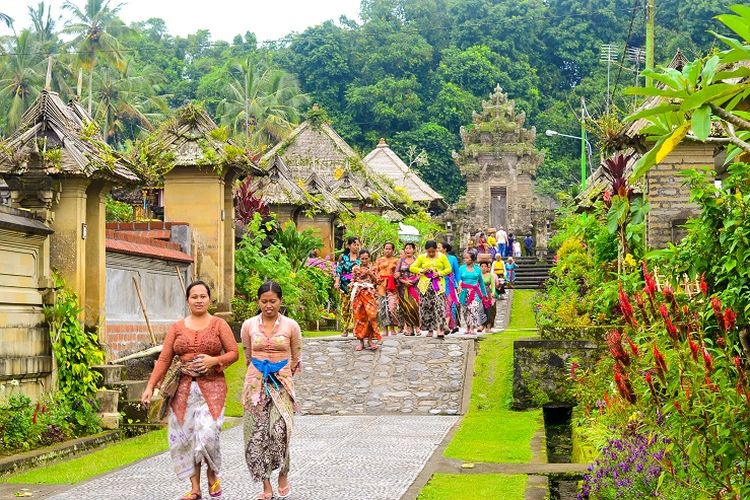
Bali is a province in Indonesia whose provincial capital is Denpasar. Bali is also one of the islands in the Nusa Tenggara Islands. At the beginning of Indonesia's independence, this island was included in the Lesser Sunda Province, which has a capital city in Singaraja, and is now divided into 3 provinces: Bali, West Nusa Tenggara and East Nusa Tenggara.Apart from consisting of Bali Island, the province of Bali also consists of smaller islands around it, namely Nusa Penida Island, Nusa Lembongan Island, Nusa Ceningan Island, Serangan Island and Menjangan Island.
Geographically, Bali is located between Java Island and Lombok Island. The majority of Balinese people are Hindus. In the world, Bali is known as a tourism destination with a unique variety of arts and culture, especially for Japanese and Australian tourists. Bali is also known as the Island of the Gods and the Island of a Thousand Temples.
Bali Island is part of the Lesser Sunda Islands, 153 km long and 112 km wide, about 3.2 km from Java Island. Geographically, Bali is located at 8 ° 25'23 ″ South Latitude and 115 ° 14'55 ″ East Longitude which makes it tropical like the rest of Indonesia.
Mount Agung is the highest point in Bali at 3,148 m. This volcano last erupted in March 1963. Mount Batur is also one of the mountains in Bali. About 30,000 years ago, Mount Batur erupted and produced a terrible disaster on earth. In contrast to the northern part, the southern part of Bali is a lowland area which is flowed by rivers.
Based on the relief and topography, in the middle of Bali Island, there are mountains that stretch from west to east and between these mountains are volcanic clusters, namely Mount Batur and Mount Agung as well as non-volcanic mountains, namely Mount Merbuk, Mount Patas and Mount Seraya. The existence of these mountains causes the Bali Region to be geographically divided into 2 (two) unequal parts, namely North Bali with its narrow and less sloping lowlands and South Bali with wide and gently sloping lowlands. The slope of Bali Island consists of flat land (0-2%) covering an area of 122,652 ha, undulating land (2-15%) covering an area of 118,339 ha, steep land (15-40%) covering an area of 190,486 ha and very steep land (> 40%). covering an area of 132,189 ha. Bali Province has 4 (four) lakes located in mountainous areas, namely Lake Beratan or Bedugul, Buyan, Tamblingan, and Batur. The beautiful nature of Bali makes the island of Bali famous as a tourist area.
The capital city of Bali is Denpasar. Other important places are Ubud as a center for arts and resorts, located in Gianyar Regency. Nusa Lembongan is a dive site, located in Klungkung Regency. Meanwhile, Kuta, Seminyak, Jimbaran and Nusa Dua are some of the places that are the main tourism destinations, both beach tourism and resorts, spas, etc., which are located in Badung Regency.
The total area of the Province of Bali is 5,636.66 km2 or 0.29% of the territory of the Republic of Indonesia. Administratively, Bali Province is divided into 8 districts, 1 municipality, 55 districts and 701 villages / wards.
The Japanese occupied Bali during World War II and at that time a military officer named I Gusti Ngurah Rai formed a Balinese 'freedom fighter'. Following the surrender of Japan in the Pacific in August 1945, the Dutch immediately returned to Indonesia (including Bali) to reestablish their pre-war colonial rule. This was opposed by the Balinese resistance forces who at that time used Japanese weapons.
On November 20, 1945, the Puputan Margarana battle broke out which took place in Marga village, Tabanan Regency, Central Bali. Colonel I Gusti Ngurah Rai, 29, led his troops from eastern Bali to carry out attacks to the death on heavily armed Dutch troops. All members of the Balinese battalion died and made it the last Balinese military resistance.
In 1946, the Dutch made Bali one of the 13 regions of the newly proclaimed State of East Indonesia, namely as a rival country to the Republic of Indonesia which was proclaimed and headed by Sukarno and Hatta. Bali was later also included in the Republic of the United States of Indonesia when the Netherlands recognized Indonesia's independence on December 29, 1949. In 1950, Bali officially left its union with the Netherlands and legally became a province of the Republic of Indonesia.
The eruption of Mount Agung which occurred in 1963, had shaken the people's economy and caused many Balinese people to transmigrate to various other areas in Indonesia.
1965, along with the failure of the coup by the G30S against the national government in Jakarta, Bali and many other areas, there was a crackdown on members and sympathizers of the Indonesian Communist Party. In Bali, it is estimated that more than 100,000 people were killed or disappeared. However, the events during the early days of the New Order have not been legally disclosed until now.
Terrorist attacks have occurred on October 12, 2002, in the form of the 2002 Bali Bombing attacks in the Kuta Beach tourism area, which left 202 people dead and 209 others injured. The 2005 Bali Bombing attacks also occurred three years later in Kuta and Jimbaran beach. These incidents received wide international coverage as most of the victims were foreign tourists and caused the Bali tourism industry to face tough challenges in recent years.
Demographics
The population of Bali is approximately 4,236,983 people (2019) with a majority of 86.91% adhering to Hinduism. Other religions are Islam (10.05%), Protestant Christianity (1.56%), Catholicism (0.79%), Buddhism (0.68%), Confucianism (0.01%), and Faith (less than 0 , 01%). [5]
Apart from the tourism sector, Balinese people also live from agriculture and fisheries, the most known world from agriculture in Bali is the Subak system. Some also choose to be an artist. The languages used in Bali are Indonesian, Balinese and English, especially for those who work in the tourism sector.
Balinese and Indonesian are the languages most widely spoken in Bali and like other Indonesians, the majority of Balinese people are bilingual or even trilingual. Although there are several dialects in the Balinese language, in general Balinese people use a form of social Balinese as an option in communicating. Traditionally, the use of various dialects of the Balinese language has been determined based on the color chess system in the Hindu Dharma religion and clan membership (Balinese terms: soroh, gotra); although the implementation of these traditions tends to decrease. In several places in Bali, a number of Javanese speakers were found.
English is the third language (and the main foreign language) for many Balinese people who are influenced by the great needs of the tourism industry. Employees who work at tourist information centers in Bali, often also understand several foreign languages with sufficient competence. Japanese is also a priority for education in Bali.
Economy
Three decades ago, the Balinese economy was largely reliant on and based on agriculture both in terms of output and employment. Now, the tourism industry is the biggest revenue object for Bali. As a result, Bali has become one of the richest regions in Indonesia. In 2003, around 80% of Bali's economy was dependent on the tourism industry. At the end of June 2011, the non-performing loans of all banks in Bali were 2.23%, lower than the average non-performing loan of the Indonesian banking industry (around 5%). The economy, however, suffered significantly as a result of the 2002 Bali Bombings and the 2005 Bali Bombings. The tourism industry itself has recovered from these events.
Tourism
Bali is the belle of Indonesian tourism which is well known throughout the world. Apart from being famous for its natural beauty, especially its beaches, Bali is also famous for its unique and interesting arts and culture. The tourism industry is centered in South Bali and in several other areas. The main tourist locations are Kuta and surrounding areas such as Legian and Seminyak, eastern areas of cities such as Sanur, city centers such as Ubud, and in southern areas such as Jimbaran, Nusa Dua and Pecatu. Bali as a complete and integrated tourist destination has many interesting tourist attractions, including: Kuta Beach, Tanah Lot Temple, Padang - Padang Beach, Lake Beratan Bedugul, Garuda Wisnu Kencana (GWK), Lovina Beach with Lumba Lumbanya, Besakih Temple , Uluwatu, Ubud, Munduk, Kintamani, Amed, Tulamben, Menjangan Island and many others. Now, Bali also has several tourist centers that are full of education for children such as a zoo, three-dimensional museum, a water playground, and a turtle breeding ground.
Transportation
Bali does not have a railroad network but the road network on this island is very good compared to other areas in Indonesia, the road network is well available, especially to tourist destination areas, namely Legian, Kuta, Sanur, Nusa Dua, Ubud, etc. Most residents own private vehicles and choose to use them because public transportation modes are not well available, except for taxis and tourism transportation. The mass transportation mode is currently being prepared so that Bali is able to provide more comfort to tourists. Recently, to serve the needs of proper mass transportation on the island of Bali, Trans Sarbagita (Trans Denpasar, Badung, Gianyar, Tabanan) was launched using a large bus with AC facilities at a rate of Rp. 3,500.
Until now, transportation in Bali has generally been built in the southern part of Bali around Denpasar, Kuta, Nusa Dua and Sanur while the northern region lacks good accommodation.
Types of public transportation in Bali, among others:
-Dokar, a vehicle using a horse as a tow is known as a wagon elsewhere.
-Ojeks, motorbike taxis (some are based on the internet).
-Bemo / public transportation, serving within and between cities.
-Trans Sarbagita buses (Corridor 1 <City - Garuda Wisnu Kencana (GWK)>) and (Corridor 2 <Nusa Dua - Batubulan>).
-Taxis (some already have an application on their smartphone).
-Komotra, a bus that serves trips to the Kuta beach area and its surroundings.
-Bus, serving intercity, rural, and inter-provincial relations.
Bali is connected to the island of Java by a ferry service that connects Gilimanuk Port in Jembrana regency with Ketapang Port in Banyuwangi Regency which takes about 30 to 45 minutes. The crossing to Lombok Island via Padangbai Port to Lembar Harbor takes about four to five hours depending on the weather.
Air transportation is served by Ngurah Rai International Airport with destinations to major cities in Indonesia, Australia, Singapore, Malaysia, Thailand, Timor Leste, China and Japan. The runway and airplanes that come and go can be seen clearly from the beach and become a kind of additional entertainment for tourists enjoying Bali's beaches.
For land transportation between islands in Bali, there is the Ubung-Denpasar terminal and the Mengwi terminal which connects the island of Bali with Java and Lombok. The Ubung Terminal on the island of Bali serves various routes between the islands of Jakarta, Bandung, Semarang, Yogyakarta, Surabaya, Malang, Madura, Jember, etc. Inter-island transportation is served by a large bus fleet with economy, business and executive classes. Ubung Terminal is relatively busy from 15.00 - 18.00 WITA because at that time many buses start to depart for their respective destinations. For those of you who come to this terminal, please be vigilant because there are many brokers who force passengers a bit.
SOURCE: WIKIPEDIA



0 Comments